About us
In the lush, temple-dotted landscape of Kerala, a quiet but profound revolution has been taking place to preserve one of humanity’s oldest intellectual traditions. The Vaidika Vijnana Kendram, located in Perumanna, near Kozhikode (Calicut), stands as a modern guardian of ancient wisdom. At a time when the oral traditions of the Vedas and the intricate rituals of temple worship were facing the corrosive effects of modernization, this institution emerged to ensure that the "Science of the Vedas" (Vaidika Vijnana) did not fade into history.
The Historical Context
To understand the significance of the Kendram, one must understand the unique position of Kerala in Vedic history. The region is home to the Namboothiri Brahmins, a community renowned for preserving the Vedas in their purest, most archaic forms, particularly the Krishna Yajurveda and the Rigveda. Unlike in other parts of India, where Vedic chanting often adapted to regional musical styles, the Kerala tradition maintained a strict, unadorned adherence to Svara (tonal accents) and Ucharana (pronunciation) believed to date back millennia.
However, by the late 20th century, the traditional Gurukula system was collapsing. Fewer families were sending their children to study the Vedas, and the number of qualified priests capable of performing complex temple rituals was dwindling. It was in this atmosphere of cultural anxiety that the Vaidika Vijnana Kendram was conceived.
Establishment and Vision
The Vaidika Vijnana Kendram was established around 1995 under the visionary leadership of Vayappuram Narayanan Namboodiri. Located in the serene village of Perumanna, the institution was not built merely as a school, but as a revival movement.
The founder recognized a critical gap: while there were academic scholars who knew the theory of the Vedas, and hereditary priests who knew the practice, the connection between deep knowledge (Jnana) and ritual application (Prayoga) was breaking down. The mission of the Kendram was to bridge this gap, producing a new generation of scholars who were not just chanters, but knowledgeable custodians of the tradition.
The Gurukula Model
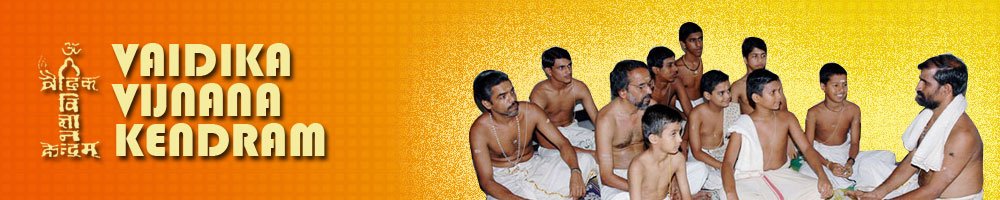
The Kendram operates on the principles of the ancient Gurukula system. It is a residential institution where students live with their teachers, fostering a bond that goes beyond the classroom. The lifestyle is rigorous, designed to instill discipline (Vinaya) and mental focus (Chitta Ekagrata).
Days typically begin before dawn, during the Brahma Muhurtham, a time considered ideal for learning and meditation. This immersion ensures that the students do not just memorize texts but internalize the Vedic way of life, characterized by simplicity, cleanliness, and devotion.
The Pillars of Curriculum
The academic and practical training at the Kendram rests on three major pillars:
- Veda (The Knowledge) — The core of the syllabus is the study of the Vedas, with a specific focus on the Krishna Yajurveda, which is the liturgical backbone of most rituals in South India. Students spend years mastering the chanting, which involves complex mathematical patterns of recitation (such as Jata and Ghana) designed to prevent errors in oral transmission.
- Tantra (The Ritual Technology) — Kerala is famous for its distinct style of temple worship, governed by Tantra Shastra. The Kendram is one of the few places that offers structured training in this discipline. Students are taught the Shodasa Kriyas (the sixteen essential purification rites) and the intricate procedures for conducting Poojas, Homams (fire rituals), and festivals. This training is vocational as much as it is spiritual; it prepares students to serve as Melsaanthis (Chief Priests) in temples, a role that demands high precision and purity.
- Sanskrit (The Language) — To ensure that the Vedas are not just mindless sounds to the students, the Kendram emphasizes the study of Sanskrit. By understanding the grammar and semantics of the language, students gain access to the vast library of Indian philosophy, astronomy (Jyothisha), and architecture (Vasthu).
Cultural Impact and Significance
Preservation of Intangible Heritage: In an era of digitalization, the Kendram protects an "oral library." By training young minds to hold these vast texts in their memory, they ensure the survival of the Vedic sound culture.
Servicing the Temples: With thousands of temples in Kerala requiring daily rituals, the Kendram serves as a vital pipeline, providing qualified, disciplined, and knowledgeable priests who uphold the sanctity of these spaces.
Documentation and Publication: Through its publication wing (often associated with the name Vaidika Sarathi), the center has produced literature that demystifies rituals for the common man, making Vedic knowledge accessible to the laity.
Conclusion
The Vaidika Vijnana Kendram is more than an educational institution; it is a cultural fortress. It stands as a testament to the belief that ancient wisdom is not antithetical to the modern world but is, in fact, essential for its spiritual grounding. By harmonizing the discipline of the past with the necessities of the present, Vayappuram Narayanan Namboodiri and his institution have ensured that the sacred chants of the Vedas will continue to resonate in Kerala for generations to come.